Primer
What Bran took from Smuggler’s Hollow, why the cave is dangerous, and how this adventure follows Got Your Goat.
“Low tide shows you what the sea has been hiding. High tide reminds you who owns it.”
Old dockside saying
This adventure is designed for three to seven characters of levels 3–5 and is optimized for five characters with an average party level (APL) of 3. Characters outside this level range can still be used with encounter adjustments.
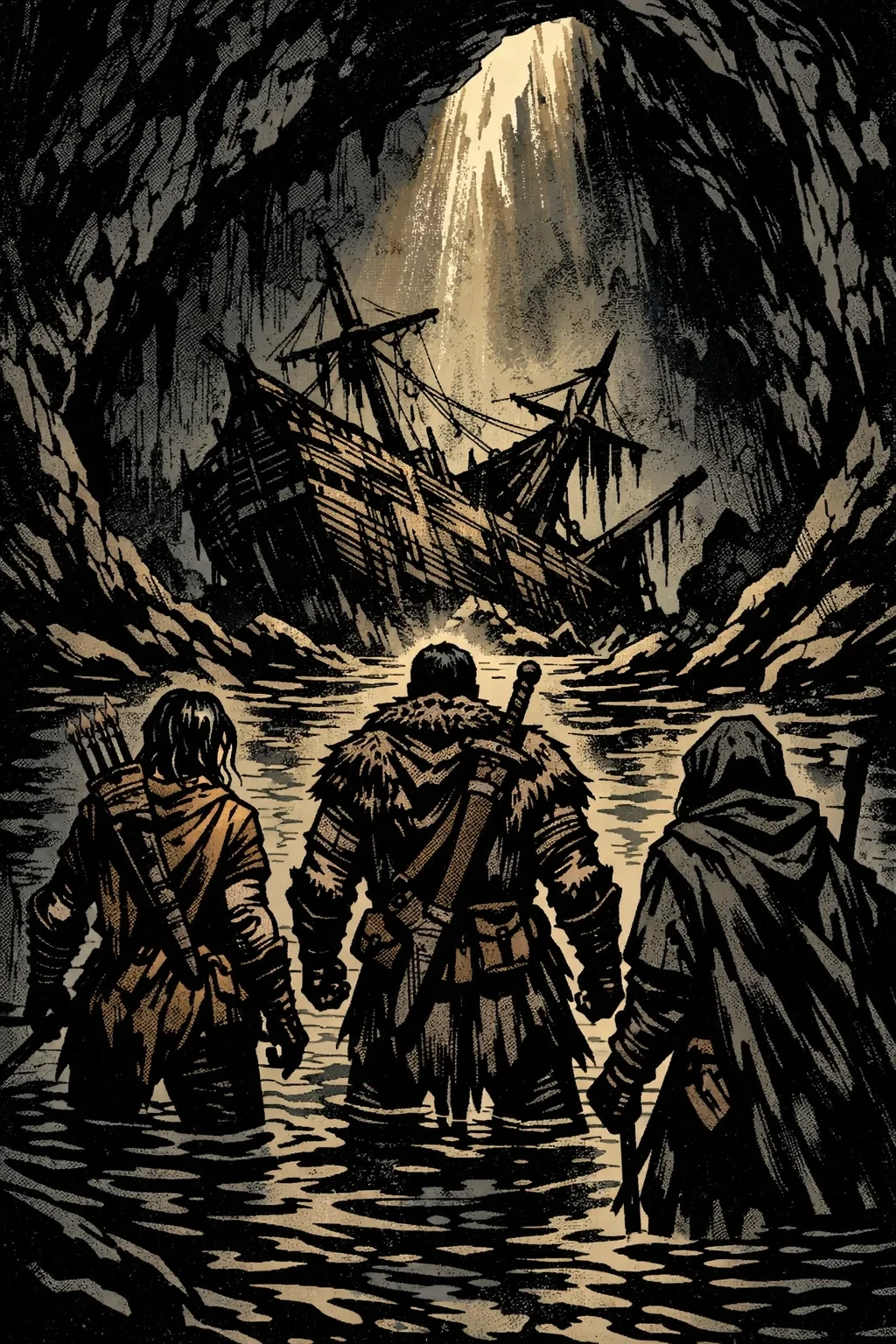
This adventure occurs on the Sword Coast, a short march from the Friendly Arm Inn, where a sandbar at low tide leads to a sea cave cut into the cliffs above the Sword Sea.
Background
The Cloak Wood presses hard against the sea south of Baldur’s Gate, a stretch of coast where the tree line leans over rock and salt spray. In places the forest breaks into tight coves and knife-edged inlets that ships avoid unless they are desperate or hunting privacy. One such cove sits off the Coast Way, reachable by a narrow game trail and a low-tide sandbar. From the water it looks like broken stone and shadow. From land it smells like wet pine, tar, and old rope.
Locals have a name for it: Smuggler’s Hollow. No signpost marks it. The name is traded in taverns the way people trade warnings, quietly, and only once.
The Wreck That Started It
Long ago, chartered a cutter called the Lantern of Iriolarthas limped along the Sword Coast with a locked hold and a crew told not to ask questions. The cargo was never meant for a merchant ledger. It was a small collection of Netherese relics purchased through proxies and recovered from a crumbled cache inland, bound for evaluation and secure study within Candlekeep.
A late-season storm drove the Lantern south. With the open sea trying to tear it apart, the ship took shelter in the Cloakwood cove. The cove saved the hull from the worst of the swell, then broke it anyway on submerged rock when the wind shifted. The cutter wedged into the cliffside sea cave at low tide, half dragged, half swallowed. The survivors stripped what they could, then realized the truth. Some of the relics were unstable. Some were hungry. Transporting them again would spread the danger to the road and to Candlekeep’s gates.
So they made a hard choice. They hid the worst of the haul inside the cave, sealed the approach with trapwork and stonework.
The magic items, though, attracted the attention of strange beings, like aboleths, who have sent their minions in search of the treasure. At least one found it, a chuul, but it has been unable to escape and trapped in a watery prison.
The Lantern’s loss became a story that never quite died. It grew teeth in the telling. One-eyed fishers spoke of lantern light flickering in the cave on moonless nights. Cloakwood charcoal burners claimed they heard singing from below the rocks, like a choir underwater.
Pirates, Smugglers, and Abandoned Tunnels
The cove’s secrecy proved too useful to stay forgotten. Over the decades, pirate crews and coastal smugglers found Smuggler’s Hollow and used the outer caves as a bolt-hole: a place to stash contraband, mend sails, hide from patrols, and wait out heat from Baldur’s Gate or the Flaming Fist.
Those crews never lasted. Some were chased off. Some turned on each other. A few simply vanished.
What remained were signs of layered trespass and abandonment:
- Outer caves that show old pirate use: soot-stained ceilings, broken crates, rope scars on stone, rusted hooks, and crude markings that once guided torchlight in.
- Collapsed side tunnels and bricked-up passages where one crew tried to “improve” the place and buried themselves in the attempt.
- False leads and dead ends meant to misdirect anyone following a pirate map. Some were built by pirates. Some feel older than pirates.
Yet for all the traffic near the mouth, the true prize stayed locked away. The inner sections do not feel like a smuggler’s den. They feel like a vault that learned to hate footsteps. The traps are too deliberate. The stonework is too old. The warnings are not carved in the common tongue.
Pirates came close, then quit. Or died. Or ran out screaming about “chains” and “a ship inside the rock.”
Bran’s Discovery
Branwick Larkspur heard the Smuggler’s Hollow tale the way he hears most things: in bits, from people who wanted their ale paid for. He also heard the part that mattered. “There’s a cave that only opens proper at low tide,” they said, “and something old sits near the entrance, like it wants to be found.”
Bran waited for a low tide and followed the trail into the Cloakwood. He found the cove. He found the sandbar. And just inside the cave mouth, tucked beneath a lip of stone above the high-water line, he found a small, cold object that did not belong in any pirate stash. It felt clean in his hand, free of barnacle and salt, as if the sea refused to touch it.
He took it and left. He did not go farther.
Bran claims that as he turned back, he heard a sound from deeper within. Not waves. Not wind. A slow scrape, like iron dragging over stone, and then a single heavy breath that did not match his own.
Who Comes After
Bran’s theft does not stay quiet.
- A low-tide hunting band of sahuagin, led by a sahuagin baron, has begun working the shallows around the cove. They do not patrol like beasts. They search like soldiers.
- Orren Sable, if he survived Adventure 001, has learned there is a cave with a story and a fool bragging about finding it. He brings goons, rope, and the certainty that anything worth hiding is worth taking. If Orren died, this second pursuit does not exist.
Orren Sable Continuity
Check the state recorded after the farm-road ambush in Got Your Goat.
- Orren survived and is free: use his pursuit and Wreck Hall arrival.
- Orren survived in custody: establish that his crew bribed a handler, intercepted the transfer, or helped him escape. Then use his pursuit and Wreck Hall arrival.
- Orren died: there are no pursuers. Do not replace him with Mara, another bandit captain, or an unexplained crew. The sahuagin threat and the chuul still carry the adventure.
And beneath all of it, the cave waits with the patience of stone and the certainty of the tide. The pirates used the outer tunnels and lived. The locked treasure has stayed sealed for a reason.
Overview
The adventure has three story parts presented across five reader chapters and takes approximately 4 hours to play.
- Part 1: The Sandbar Run (Chapter 1). The party crosses at low tide while sahuagin and reef sharks turn the shallows into a killing ground. Story Objective A is to reach the cave mouth alive.
- Part 2: The Sea Cave Gauntlet (Chapters 2–4). Chapter 2 establishes the dungeon framework and rising-tide rules. Chapter 3 covers the Pirate Layer. Chapter 4 covers the Vault Layer, including Thols and the engineered containment puzzles. Story Objective B is to reach the wreck chamber before the tide turns.
- Part 3: The Wreck Hall (Chapter 5). If Orren survived and remained free, he arrives as the chuul attacks and creates a three-way fight. If he died, no pursuers arrive and the finale is a direct fight against the chuul. Story Objective C is to survive the Wreck Hall and escape before the cave floods.
Adventure Hooks
To get the adventure started, you can use any of the following adventure hooks:
- Bran’s Confession. If the party completed the Got Your Goat Adventure, Bran admits he stole the item from a sea cave across the way. He offers the party a cut of whatever else is inside if they come now, at the next low tide.
- Quentin’s Interest. A sealed note arrives for the party or for Bran, signed “Q.” It is short, cold, and hungry for details about “a coastal vault” and “a device older than the cliffs.” The note implies payment for anything recovered, and consequences for anything lost.
- Missing Fisherfolk. Locals near the Friendly Arm have lost two fishers in the last tenday. The bodies washed up with neat, round bite marks and salt-crusted prayers to Umberlee stuffed into their mouths. Someone is offering coin for “proof the shore is safe again.”
- A Rival’s Shadow. Use this hook if Orren survived Adventure 001, whether he escaped the farm road or later escaped custody. A party member spots his colors in a passing wagon or hears his name in a tavern whisper. If Orren died, omit the hook and make clear that no one is following the party from the Friendly Arm.
- Storm-Feel in the Air. Spellcasters notice a pressure in the lungs and a faint, metallic taste when the wind blows from the cliffs at low tide. Something down there is active, awake, or trying to be.
The Sandbar Run
Cross the exposed bar under a ticking tide clock while sahuagin turn shallow water into a killing ground.
Estimated Duration: 45-60 minutes
The characters reach Smuggler’s Hollow at low tide, cross a narrow sandbar, and are attacked in the shallows by sahuagin led by a . The baron uses a crude blood-rite to draw reef sharks into water that should be too shallow for comfort. The goal is simple. Reach the cave mouth alive.
Intended Outcome
This part should end with the party standing at the sea cave entrance, bloodied, wet, and aware that time matters. The tide is already turning.
Story Objective A
Reach the cave mouth alive.
Scenes
1.1 The Cloakwood Trail to Smuggler’s Hollow (exploration)
1.2 The Cove at Low Tide (exploration + time pressure)
1.3 Ambush in the Shallows (combat)
1.4 Aftermath and the Mouth of the Sea Cave (resolution)
1.1 The Cloakwood Trail to Smuggler’s Hollow
This scene sets tone and gives the party a last breath before the open shore.
The Cloak Wood smells like wet needles and old smoke. Pines lean toward the wind as if listening. The ground turns sandy underfoot, then gritty, then slick with salt damp. Ahead, the trees break apart into a wedge of gray sky. You hear gulls crying over water you cannot see yet.
A cold breath of sea air hits you. It carries tar, rotting kelp, and something sharp like blood on stone.
Setting
Describe from left to right.
- Left: Dense pines and tangled underbrush. The forest here is trampled in places, as if people have used this trail before, then stopped using it.
- Center: A narrow path drops toward the coast. Old rope fibers cling to branches.
- Right: Low dunes and scrub grass. Half-buried driftwood lies like broken ribs.
Checks and Clues
- DC 12 Wisdom (Survival): Many boot prints head toward the cove. Few return. Some prints drag.
- DC 13 Wisdom (Perception): A faint fish-stink comes and goes on the breeze, stronger than the normal sea smell.
- DC 13 Intelligence (History): A character recalls this stretch of coast is avoided by small crews. Too many “bad nights” near the Cloakwood waterline.
Pacing Note
Keep this short. The fight is coming soon. Let players talk, make plans, and decide marching order.
1.2 The Cove at Low Tide
This scene shows the sandbar and establishes a clock.
The trees end at a hard drop of stone and sand. Below, a small cove opens like a bite taken out of the coast. Dark cliffs wrap the water on three sides. At low tide the sea pulls back, exposing a pale sandbar that leads to a jagged gap in the cliff face.
Wet rock glistens on either side of the sandbar. Shallow pools tremble with tiny fish. Farther out, the sea is steel gray and restless.
On the cliff wall beyond the bar, a cave mouth yawns just above the waterline. The stone around it is stained black with old smoke.
The Tide Clock
The tide is low right now, then it starts coming back in.
Use a simple countdown. 6 Tide Beats until the sandbar begins to break apart under surf. After that, movement across the bar becomes dangerous.
- Beat 1-2: Easy crossing.
- Beat 3-4: Water begins to lap the edges. Difficult terrain in places.
- Beat 5-6: Waves cut across the bar. Creatures crossing must make checks (see below).
- After Beat 6: The bar is not gone, yet it is violent. Each round, a wave can knock creatures off their feet and into deeper water.
Advance the tide by 1 beat when any of these happen
- The party spends about 2 minutes discussing or scouting at the overlook.
- Combat starts.
- Two full rounds of combat pass.
- The party spends time looting or arguing after combat.
Sandbar Crossing Rules
The sandbar is 10 feet wide at its widest, narrowing to 5 feet near the rocks.
- Wet Sand: Normal terrain.
- Rivulets and Pools: Difficult terrain.
- Slippery Rock Edges: If a creature moves onto the rocks, it must succeed on a DC 12 Dexterity saving throw or fall prone.
When the Party Scouts
If the party tries to study the cove before crossing, they can spot the threat.
- DC 14 Wisdom (Perception): Dark shapes cling to rocks in the shallows on both sides of the sandbar.
- DC 16 Wisdom (Perception): A heavier figure crouches behind a boulder at the far side, watching the bar like a hunter watches a trail.
- DC 13 Intelligence (Nature): The shallow pools are big enough for sharks to surge through, for a moment, if something draws them.
If they detect the ambush, the sahuagin wait until the party reaches the midpoint, then strike anyway. They want the bar to be a trap.
1.3 Ambush in the Shallows
This is the set-piece fight. Make it fast, wet, and mean. The sahuagin are not here to die for sport. They want the party scattered, bleeding, and dragged.
Combat Setup
- Two sahuagin hide in the water on the left of the sandbar.
- Two sahuagin hide in the water on the right of the sandbar.
- The waits near the far side, partly behind rocks, within 30 feet of the cave-side shore.
- Reef sharks appear when the baron performs the blood-rite (see below).
A ripple runs through the shallow water to your left. Then another to your right. A gray fin cuts the surface, too close to be a fish.
Something rises from the shallows. It is man-shaped and wrong, skin like wet stone, teeth too many. It hisses a word that sounds like a curse and a prayer at once.
On the far side, a larger one steps up onto the rocks. It wears crusted armor and carries a spear like it has used it on ships. It drags a blade across its own palm and lets the blood drip into the tide pool at its feet.
The water answers.
Battlefield Features
Describe from left to right.
- Left (Shallows): Knee-deep water with slick stones. A creature that starts its turn here must succeed on a DC 12 Dexterity saving throw or have its speed reduced by 10 feet until the end of the turn (slipping and regaining footing).
- Center (Sandbar): A narrow strip with shallow rivulets. Two Medium creatures can fight abreast only in a few spots.
- Right (Rocks): Jagged stones and tide pools. A creature shoved here risks falling prone and sliding into water.
- Far Side (Cave-Side Shore): A small wedge of wet sand and rock with a few boulders for cover. The cave mouth looms above, black and smoky-stained.
Time Pressure During Combat
At the end of round 2 and every 2 rounds after, increase the tide by 1 beat. The party should feel the water rising at their ankles.
Enemy Tactics
Run them like coastal raiders who know the ground.
Sahuagin (raiders)
- Start hidden in the shallows. They try to grapple and shove targets off the sandbar into deeper water.
- They focus on isolated targets and anyone who looks like a healer or caster.
- If a character falls into a pool, a sahuagin tries to hold them down long enough for a shark surge.
Sahuagin Baron (leader)
- The baron stays near the far side at first. It wants the party fully committed to the bar before closing.
- It uses the Blood-Call Rite as soon as at least two characters are within the center third of the bar.
- After sharks arrive, it presses with spear and blade, choosing targets already threatened by sharks.
Reef Sharks (summoned into the shallows)
- The sharks do not arrive in deep water only. They surge through channels and pools like living knives.
- They pick on wounded targets and anyone in water deeper than ankle height.
The Blood-Call Rite (Baron Feature)
This is the “sharks in shallow water” moment.
When used: The baron uses an action to cut its palm and drip blood into a tide pool while chanting.
Effect: At the start of the next round, two reef sharks surge into the shallow channels.
- The sharks appear in tide pools within 30 feet of the baron.
- If no pool is available, they appear at the edge of the sandbar where water is deepest.
Duration: The sharks remain until slain or until the baron is reduced to 0 hit points.
Limit: The baron can perform this rite once.
Environmental Hazard: The Wave Cut
Once the tide reaches Beat 5, each round on initiative count 20 (losing ties), a wave cuts across the bar.
Each creature standing on the sandbar must succeed on a DC 13 Strength saving throw or be pushed 10 feet toward the nearest water channel and knocked prone. A creature that would be pushed off the bar instead falls into a shallow pool.
Adjusting the Encounter
Use these without fuss.
If the party is weaker (3 characters, or APL 3 with low resources):
- Remove one sahuagin (total 3 raiders).
- Only one reef shark arrives.
Stronger Parties
- Add one sahuagin (total 5 raiders).
- The baron begins combat with partial cover and a javelin to punish casters.
Treasure
Keep treasure minimal here. The reward is access.
- Each sahuagin has crude bone charms worth 5 gp total if collected.
- The baron carries a salt-crusted ring of carved shell worth 25 gp to a collector in Baldur’s Gate.
- The party may find a waterlogged scrap of a pirate map jammed under a rock on the far side (foreshadowing the cave’s outer pirate use). It is not a complete map.
1.4 The Mouth of the Sea Cave
This scene pivots into the dungeon and reminds the party the tide is still a threat.
The last of the raiders slips under the surface or lies still in the sand. The gulls return, circling with ugly patience. Your breath fogs in the sea wind.
The sandbar is already changing. Water fingers across it in thin sheets, filling the channels that were dry minutes ago.
Ahead, the cave mouth waits above the wet stones. The air that comes out of it is colder than the wind outside and smells faintly of smoke that has no fire.
What the Party Sees at the Entrance
Left: Blackened stone and old soot. Someone once kept watchfires here.
Center: A sloped passage that rises slightly before turning into darkness. Old rope scars mark the rock as if heavy loads were hauled in.
Right: Tide pools and a shelf of stone where waves slap and retreat. The waterline creeps higher each minute.
Practical Notes for the DM
- If the party lingers, tick the tide up by 1 beat every couple of minutes.
- If they try to short rest here, you can allow it only if they secure a higher nook in the rocks and accept that the sandbar becomes harder to cross behind them.
- If anyone wants to track where the sahuagin came from, the answer is simple. They came from the sea, and they will come again at the next low tide.
Transition to Part 2: The Sea Cave Gauntlet
The cave mouth is the safety line and the next problem. Once the party steps inside, the sound of the sea dulls fast, as if the stone swallows it. The tide clock does not stop. It just moves from “sandbar risk” to “cave flooding risk.”
The Sea Cave Gauntlet
Establish the cave’s environmental rules: rising water, bad acoustics, treacherous footing, and the transition from pirate den to engineered vault.
Estimated Duration: 90-120 minutes
The characters push into the sea cave at the edge of Smuggler’s Hollow. The outer chambers show signs of pirate use and abandonment. Deeper passages shift into older work. The cave stops feeling natural. It starts feeling designed.
Intended Outcome
This part should feel like a treasure hunt that hates the party back. The group learns three truths through play:
- The cave has layers. Pirates used what they could reach, then stopped.
- The inner vault punishes greed, weight, noise, and haste.
- The tide is an enemy that never rolls initiative.
Story Objectives
- Reach the inner cave system before the water cuts off retreat.
- Learn the cave’s “rules” through low-stakes warnings before the big traps.
- Find the route that leads toward the wreck chamber.
Scenes
2.1 The Mouth of the Sea Cave (exploration)
2.2 Smuggler’s Fringe (exploration + minor hazards)
2.3 The First Warnings (trap signs and false leads)
2.4 Descent to the Old Work (transition moment)
For now, this section sets the scene, establishes the dungeon rules, and gives you the environmental framework to run every keyed area that follows.
2.1 Dungeon Framework
Use this as your baseline for every room you describe.
The Tide Clock Returns
Keep the tide clock from Part 1, “The Sandbar Run,” and let it keep moving. Inside the cave, the tide becomes a flooding threat.
Start Part 2 at Tide Beat 3 if the party moved quickly. Start at Beat 4 if they fought a long fight, looted, or argued.
- Beat 4: Water reaches the cave mouth and begins pushing into the first chambers.
- Beat 5: Several low tunnels start flooding. Knee-deep water appears in low spots.
- Beat 6: Fast water begins surging through narrow passages. The outer caves become dangerous to cross.
- After Beat 6: Most exits back across the sandbar become a gamble. Inside the cave, the danger shifts from “wet feet” to “forced decisions.”
Advancing the tide: Move the clock forward by 1 beat every 10 minutes of in-world time, or after any big moment like a fight, a major trap trigger, or prolonged searching in a room.
Rising Tide Effects
- Water depth in low chambers rises first.
- Certain routes become one-way.
- Noise increases. The cave begins to roar as water pressure builds.
Light and Visibility
The cave eats light fast. Torches and lanterns work, yet the humidity dampens flames and makes smoke cling.
- No natural light beyond the first bend from the entrance.
- Any open flame in cramped tunnels produces smoke that hugs the ceiling. A party crawling through tight spaces with torches risks choking and giving away position.
- Characters with darkvision see shapes, not color. That matters for warnings painted in faded pigment or for small details like wire, holes, and seams.
Sound and Acoustics
Sound behaves badly here.
- Voices carry farther than expected, then return as warped echoes.
- Metal on stone rings like a bell.
- Shouting can attract trouble from rooms you have not keyed yet. Treat loud noises as a trigger for a roaming hazard once per scene.
The Cave’s Smell
Use smell as a clue tool.
- Outer caves: tar, old smoke, wet rope, spoiled fish, mold.
- Middle caves: mineral cold, brine, bat musk, old blood in stone pores.
- Inner work: dry dust that should not exist in a sea cave, faint ozone, and a stale, cellar-cold air that does not match the coast.
Floors, Walls, and Movement
Keep players uneasy with footing.
- Slick stone counts as normal terrain until pressure hits, then it turns into a hazard mid-room.
- Shallow water hides holes, barnacled rock edges, and dropped gear.
- Climbing costs time. Time costs tide beats.
Movement Hazards
- Slick Rock: DC 12 Dexterity saving throw when a creature dashes or is shoved. On a failure, it falls prone.
- Hidden Drop: DC 13 Wisdom (Perception) to spot. A creature that misses it and moves through falls 5 feet into a pool or crevice, takes 1d6 bludgeoning damage, and makes noise.
Pirate Layer vs. Vault Layer
The dungeon has two distinct “hands” that shaped it.
The Pirate Layer
- Soot stains from watchfires.
- Rope grooves in stone.
- Crates, hooks, old nails, broken lantern glass.
- Chalk marks, crude arrows, and short warnings in Common.
- False doors, bricked-up side holes, and dead ends meant to mislead pursuers.
The Vault Layer
- Worked stone that does not match the coast.
- Seam lines that look too straight for nature.
- Traps that reset, or that feel designed to punish second attempts.
- Symbols that do not read like pirate graffiti. They read like instruction.
As the party goes deeper, the pirate layer fades. The cave becomes quieter, drier, and more deliberate.
The Dungeon’s “Tone Rules”
These are not mechanics so much as running principles. Keep them consistent.
- The cave gives warnings once. After that, it takes payment.
- Greed triggers traps. Weight triggers traps. Noise triggers traps.
- The safest path looks wrong. The obvious path looks inviting.
- A trap is not a single roll. It is a small scene.
Resting Inside
Short rest. The party can rest in a dry niche or behind a barricade, but the rest is never free. Roll 1d3 or choose one complication.
| d3 | Complication |
|---|---|
| 1 | The tide advances 1 beat. |
| 2 | Something scouts the party’s position. |
| 3 | Exposed gear gets wet and is ruined. |
Long rest. Not recommended. If the party tries, the tide and enemies force an outcome.
Loot Handling
Use loot as temptation and as trap fuel. Coins and trinkets add weight. Weight matters later.
The Pirate Layer
Follow evidence left by people who survived long enough to learn that noise, weight, order, and restraint matter.
3.1 Mouth of the Sea Cave
This is the threshold. It should feel like stepping out of the world and into a mouth.
The cave mouth opens in black stone like a wound in the cliff. The wind dies as you step inside, replaced by damp cold that clings to your skin. Water drips somewhere deeper, slow and patient.
The floor rises a few feet, then slopes down again, as if the cave wants to draw you in and hold you there. Soot stains the ceiling near the entrance. Old smoke, old fires, old watchers.
Behind you, the sea keeps breathing. Each exhale pushes the waterline a little closer.
Setting
Describe from left to right.
- Left: A stack of stones forms a half-collapsed windbreak. Someone once sheltered a fire here. Broken shells crunch underfoot.
- Center: A worn track leads inward, then splits around a rock spur. Rope scars cut grooves into the stone at shin height.
- Right: A tide pool fills a bowl in the rock. The pool reflects torchlight like oil. A narrow ledge skirts it.
Clues and Checks
- DC 12 Wisdom (Perception): You spot old boot scuffs and drag marks leading inward. They stop at the first bend, then resume with fewer prints.
- DC 13 Intelligence (Investigation): Pirate chalk marks remain on the wall, mostly washed away. One symbol repeats: a crude spiral, drawn and crossed out more than once.
- DC 14 Wisdom (Survival): Several prints show bare feet with webbed toes. Something came in from the sea at low tide, not long ago.
Minor Hazard: The “Welcome” Tripwire
Pirates guarded this first bend from pursuit. It is not lethal, it is loud.
A thin cord runs ankle-height across the left track just past the rock spur. It connects to a hanging rack of shells and scrap metal.
Detect: DC 13 Wisdom (Perception)
Disarm: DC 12 Dexterity (Sleight of Hand)
Trigger: The shell rack crashes down, making a brutal clatter. Any creature within 30 feet knows someone entered.
If it triggers, treat it as a “noise event.” Something deeper shifts. You do not need to show it yet. Let the players feel it.
What Players Can Learn Here
If they stop and study, give them this for free: the outer caves were used. Someone watched this entrance. Someone cared about warning, not killing.
3.2 The Watcher’s Bend
The passage bends sharply left, cutting off the sound of the sea behind you. The ceiling lowers here, blackened with soot. The floor slopes upward slightly, then flattens into a cramped chamber where the stone walls lean inward like conspirators.
Old driftwood has been stacked into a crude windbreak against the left wall. A circle of ash marks where a fire once burned low and hot. The air smells stale, like damp rope and old breath.
Something about this place feels watched, even though it is empty.
Setting
Describe left to right.
- Left Wall: A waist-high stack of driftwood and loose stones forms a half-collapsed barricade. Several pieces are notched where rope once held them together.
- Center: A shallow fire pit filled with ash, shells, and cracked fish bones. The stone beneath is scorched dark.
- Right Wall: Two rusted iron hooks driven into the stone, one bent downward as if something heavy tore free.
- Ceiling: Low and uneven. Soot stains radiate outward from the fire pit like a black halo.
Exits
- Back: The passage curves back toward the cave mouth. Water can be heard slapping stone, louder than before.
- Forward: A narrow tunnel slopes downward and splits around a rock spur about 20 feet ahead.
Trap: Shell-Clatter Alarm
This is the pirates’ early warning system. It is crude and meant to wake sleepers or warn of pursuit.
A thin cord stretches ankle-high across the center of the room, partially hidden by ash and shadow. It connects to a hanging rack of shells and scrap iron tucked into a crack above the left exit.
- Detect: DC 13 Wisdom (Perception)
- Disarm: DC 12 Dexterity (Sleight of Hand)
- Trigger: The rack drops and shatters on stone, creating a sharp, echoing crash.
Effect.
- The noise carries deep into the cave.
Advance the Tide Clock by 1 beat as water surges harder outside.
Future encounters in the pirate section start alert rather than surprised.
Search
- A burned scrap of sailcloth stuffed into the barricade, marked with a crude anchor symbol.
- 1d6 cp and 1d4 sp scattered in the ash, left behind in a hurry.
- A half-buried copper token stamped with a stylized eye. It is not magical. It appears again later as a motif.
Mixed into the ash beneath the fire pit is a charred scrap of parchment, folded and re-folded until brittle.
- It bears four vertical marks, unevenly spaced.
- Beneath them is a single word, half-burned:
“…order.”
A successful DC 11 Intelligence (Investigation) confirms this is not a tally or map. It looks more like a reminder.
A successful DC 12 Intelligence (Investigation) reveals the fire pit was used repeatedly, then abandoned fast. This place was a watch post, not a home.
3.3 The Split Cache
The tunnel opens into a wider chamber where the stone floor breaks into two shallow ramps sloping in opposite directions. Moisture beads on the walls, catching your light in thin, trembling lines.
Crates lie smashed along the left wall, their lids torn free. On the right, a short passage dips into shadow, partially blocked by a low collapse of rock and timber.
Scratched arrows mark the stone near your feet. Some point left. Others have been angrily crossed out.
Setting
- Left Side: Broken crates, rotten burlap, and splintered planks. The smell of spoiled grain and old citrus lingers.
- Center: The floor slopes gently down, slick with algae in places. Several sets of boot prints overlap and smear here.
- Right Side: A half-blocked crawlway reinforced with old timbers. One support beam has cracked and bowed inward.
Exits
- Left Ramp: A wider tunnel that looks easy to traverse.
- Right Crawlway: A narrow, partially collapsed passage that requires squeezing.
Trap: The False Cache
The left tunnel is bait.
About 15 feet down the left ramp, the floor hides a drop panel disguised with loose planks and sand.
- Detect: DC 14 Wisdom (Perception)
- Trigger: A Medium or heavier creature steps fully onto the panel.
Effect.
- The floor drops 6 feet into a shallow pit lined with broken crate nails and sharp stone.
- The creature falls prone, taking 1d6 piercing damage.
- The noise echoes sharply. Advance the Tide Clock by 1 beat.
This pit once held a small stash. Pirates cleared it, then left the trap behind to punish pursuers.
The Right Crawlway (Safer Path)
The crawlway looks worse but is stable.
- Requires Medium creatures to squeeze for 10 feet.
- Movement is slow and uncomfortable, but there is no trap.
A character who chooses this route and succeeds on a DC 12 Wisdom (Survival) notices the rock here feels more solid and less worked by water.
Search
Left (after dealing with the pit).
- Empty crates stamped with faded Candlekeep import marks.
- A cracked glass vial that once held lamp oil.
Right (crawlway).
- A wrapped bundle of pitch-soaked rags and flint.
- 15 feet of usable rope, stiff with salt but intact.
Clues
A successful DC 13 Intelligence (Investigation) reveals the arrows on the floor were changed over time. Different crews argued about the “right” way through. The safest path looked like the worst one.
Left Ramp (False Cache Pit)
Among the shattered debris at the bottom of the pit is a broken stone pipe, snapped clean rather than corroded.
It is smooth, cylindrical, and not cargo-shaped.
A successful DC 12 Intelligence (Investigation) suggests it was part of a structure, not a trade good.
Scratched beside it, almost hidden by grit
“Don’t take it apart.”
DM Note: This primes the organ trap. Someone tried to steal the mechanism.
3.4 The Tally Chamber
The passage opens into a long, low chamber where the ceiling dips close enough to brush your head. The floor here is flat and smooth, worn by many feet and dragged loads.
On the far wall, tallies have been carved into the stone. Dozens of them. Some neat. Some jagged. Some scratched out so hard the stone flakes away.
The air feels heavier here. Damp, but not flooded. Water drips in a slow, patient rhythm from cracks overhead.
Setting
- Left Wall: Rows of tally marks in different styles. Some are grouped. Some stand alone.
- Center: A clear stone floor with faint grooves running lengthwise, like rails without metal.
- Right Wall: A narrow ledge above a shallow water channel that hugs the wall.
Exits
Forward: A descending passage that slopes toward darker, quieter stone.
Right: A ledge that continues along the wall for 20 feet before rejoining the main path.
Hazard: The Weight Test
This chamber reacts to load.
The stone floor in the center is mounted on pressure points hidden beneath it. It does not collapse. It sinks.
When the combined weight of creatures and carried gear in the center exceeds a threshold, water begins forcing up through seams.
Trigger.
- Three or more Medium creatures stand in the center at once, or
- One creature wearing heavy armor remains stationary here for more than one round.
Effect.
- Thin jets of seawater spray up through the floor.
- The floor becomes slick difficult terrain.
- After 2 rounds, water reaches ankle height.
If the party lingers or ignores this, advance the Tide Clock by 1 beat.
Safe Movement
- Moving along the right ledge avoids the pressure points.
- Keeping weight spread out prevents the hazard entirely.
Search
- A leather tally pouch wedged into a crack, containing 12 sp and a shark tooth charm.
- One tally group has a carved symbol matching the copper token found earlier.
Clues
A successful DC 13 Wisdom (Perception) notes that no tallies continue past this room. This was the last place pirates counted heads before deciding who went farther.
A successful DC 14 Intelligence (History) suggests this chamber was used to judge risk. People stopped here. They turned back here.
Among the tally marks are three repeating groupings
Sets of four marks
Sets of three marks
Sets of one mark, always scratched out
A successful DC 13 Wisdom (Perception) notices
The four-mark sets are never crossed out.
The single marks always are.
DM Note: This mirrors “wrong note collapses floor” logic later.
3.5 The Study Nook (Optional)
This narrow side passage ends in a cramped alcove, barely tall enough to kneel in. The stone here is drier, warmer. Someone spent time in this space.
A flat stone has been dragged against the wall like a desk. Scratched lines cover its surface.
Search
On the stone slab
- A crudely sketched keyboard layout, uneven, with one key marked heavier than the others
- A sketch of a segmented floor, with one square darkened
- A note written in charcoal: “Third one drops. Always.”
Checks
- DC 12 Intelligence (Investigation): This is not art. It is trial-and-error documentation.
- DC 13 Intelligence (Arcana): The markings resemble containment diagrams seen later.
3.6 The Rope Gallery
The tunnel widens and rises into a long chamber with a ceiling lost in shadow. The walls are scored with deep grooves where ropes once dragged under load. Several still hang, stiff with salt, knotted and re-knotted so many times they look grown rather than tied.
Below, the floor drops away into a shallow basin slick with algae and black water. The sound of dripping here is constant, echoing up and back down again.
Setting
- Left Wall: Three heavy ropes descend from iron rings set high into the stone. The rings are old but solid.
- Center: A sloped stone lip drops into a basin about 10 feet below. The basin floor is uneven and slick.
- Right Wall: A narrow stone shelf runs along the wall at waist height, scraped smooth by passing bodies and crates.
Exits
- Forward (High): A ledge 12 feet up on the far side of the chamber leads to a narrow tunnel.
- Forward (Low): The basin slopes into a partially submerged tunnel that continues onward.
Movement Hazard
This chamber forces a choice: climb, balance, or drop.
Ropes.
- Appear sturdy but are salt-brittle.
- First climber is safe. Each subsequent climber must succeed on a DC 12 Strength (Athletics) check or the rope partially frays, imposing disadvantage on the next climber.
Stone Shelf.
- Requires a DC 11 Dexterity (Acrobatics) check to move along safely.
- Failure means slipping into the basin below.
Basin.
- Counts as difficult terrain.
- Water hides jagged stone. Any creature that falls in takes 1d4 slashing damage and makes noise.
Noise here echoes sharply. If the party is careless, advance the Tide Clock by 1 beat.
Search
- A rusted grappling hook still tied to one rope.
- A waterlogged crate smashed in the basin containing broken bottles and a single intact flask of cheap rum.
- Scratched into the stone near the high ledge is a message in Common: “NO FARTHER. BAD STONE.”
Clues
A successful DC 13 Wisdom (Survival) reveals the ropes were used to haul cargo up, not to descend. Pirates carried things out of here, not deeper in.
The rope grooves along the wall are evenly spaced in a repeating rhythm. A successful DC 13 Wisdom (Perception) notices:
- The spacing matches the four-mark pattern seen earlier.
- Loads were hauled in a fixed order, not randomly.
Scratched near the high ledge: “Rush breaks it.”
DM Note: Reinforces patience and order.
3.7 The Sleeping Den
This chamber is warmer than the others, sheltered from the draft. The floor is packed dirt and sand instead of bare stone. Tattered bedrolls lie where they were dropped, half-buried in grit.
The walls are carved with names, crude drawings, and insults layered over each other until none of them matter anymore. The smell here is old sweat, mold, and damp cloth.
No one has slept here in a long time.
Setting
Left: A pile of collapsed bedrolls and rotten blankets.
Center: A fire scar with a circle of smooth stones.
Right: A shallow alcove where crates once sat. Only splinters remain.
Exits
- Back: Returns to the Rope Gallery.
- Forward: A low tunnel that dips sharply downward, the air colder beyond.
Minor Hazard: Rot and Vermin
The bedrolls are infested with mold and biting insects.
- A character who rummages through them without care must succeed on a DC 11 Constitution saving throw or be poisoned until the end of their next turn by coughing and skin irritation.
Search
- A bone die carved with symbols instead of numbers.
- 2d10 sp sewn into the hem of a blanket.
- A crude charcoal drawing of a ship trapped inside stone, labeled “Lantern”.
Clues
A successful DC 12 Intelligence (History) suggests multiple crews used this den over time. No one stayed long. No one settled.
Among the crude drawings is one that stands out
- A stick figure on a grid
- Lines beneath it filling with dark shading
- A crude arrow pointing upward
Below it: “Don’t panic.”
A successful DC 12 Wisdom (Insight) reads this as fear remembered, not a joke.
3.8 The Last Turnback
The tunnel tightens and straightens, the walls smoothing into something closer to worked stone than cave. The air here is dry enough that your breath does not fog.
At the center of the passage stands a crude barricade made from broken crates, driftwood, and a shattered door reinforced with iron bands. It has been smashed outward, not inward.
Carved into the stone beside it are symbols you have not seen before. Not warnings. Instructions.
Setting
Barricade: Destroyed from the cave side. Whatever broke it came from deeper within.
Wall Markings: Lines, angles, and circles scratched with care, not panic.
Floor: Clean stone with no recent footprints.
Exits
- Back: Pirate tunnels and familiar damp stone.
- Forward: A narrow passage with worked stone walls and no pirate marks.
Environmental Effect: Silence of Stone
Sound dies faster here.
- Beyond the barricade, noise does not echo.
- Metal dropped on stone makes a dull sound, not a ring.
This should unsettle players.
Search
- Embedded in the barricade is a broken spear head, bent backward.
- Wedged behind a stone is a leather journal, pages ruined except one.
The surviving page reads: “We took coin and drink and left the rest. Weight sets it off. Noise wakes it. Don’t touch the gold.”
Clues
A successful DC 14 Intelligence (Arcana) identifies the wall symbols as containment markings, not wards. They are meant to guide behavior, not repel intrusion.
Just beyond the smashed barricade, the stone floor bears deep scoring marks, as if something extremely heavy was dragged backward—away from the vault.
A successful DC 13 Intelligence (Investigation) confirms:
- Pirates tried to brace or weigh something down.
- It did not work.
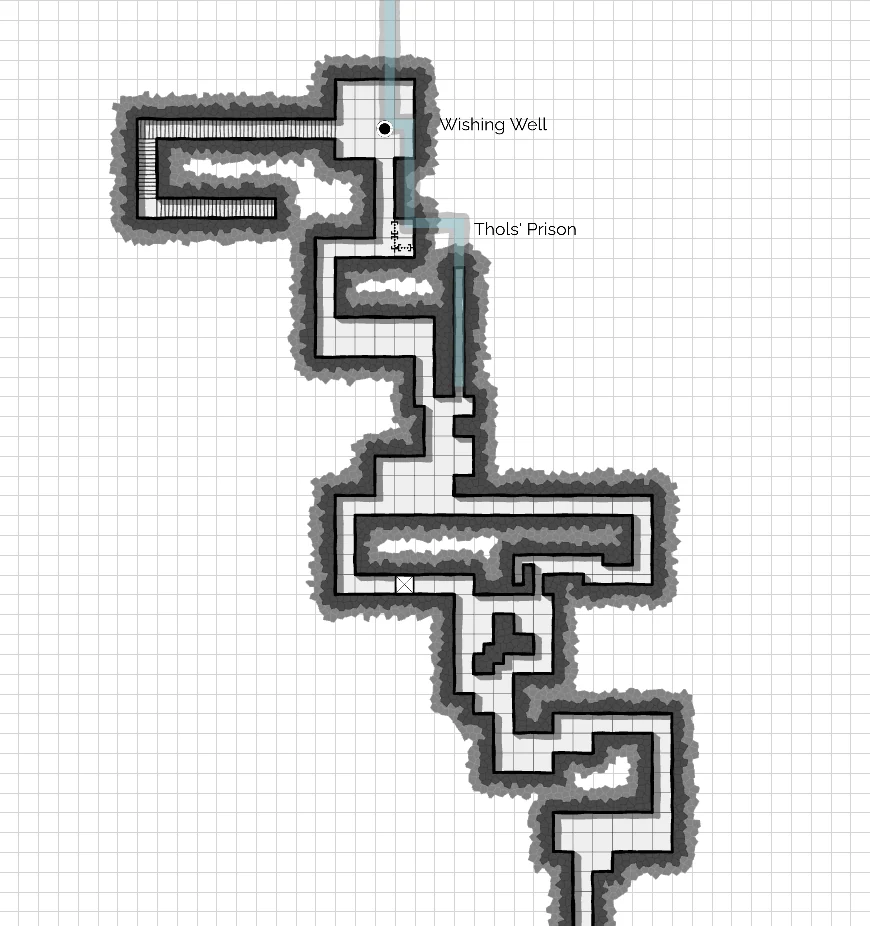
3.9 The Iron Throat (Thols’ Prison)
The passage opens into a tall chamber carved straight down into stone. Iron dominates the space. Thick chains run from the ceiling to the floor, bolted into the walls with rivets the size of fists. Some are slack. Others strain, pulled tight toward the center.
There, crouched in shadow, is a shape that breathes.
The creature is large. Bigger than any pirate you have seen. Its skin is pale and scarred, stretched tight over corded muscle. Iron bands bite into its wrists and throat, each etched with symbols worn thin by time. One chain runs straight into the stone floor, humming faintly, as if the rock itself is holding it.
When your light reaches its face, one eye opens.
It does not roar.
It does not lunge.
It exhales, slow and heavy, and says in a voice like stone dragged across stone, “Are you here to leave me… or replace me?”
Setting
Describe left to right.
Left Wall: Iron hooks and broken shackles. Some are snapped open, others torn free violently.
Center: Thols, chained to three anchor points: wrists, throat, and floor. The chains are old, but not weak.
Right Wall: A pile of bones and rusted gear. Pirate armor, weapons, and personal effects crushed and discarded.
Floor: Near Thols’ feet is a small pool of seawater. Small schools of fish can be seen glimmering.
Ceiling: A vertical shaft rises out of sight, lined with rust streaks and old scrape marks.
The Chains
There are three bindings, each serving a different purpose.
Wrist Chains (Physical Restraint)
- Can be broken with brute force or tools.
- Breaking these frees Thols’ movement but not his bond.
Throat Band (Obedience Collar)
- Etched with containment runes.
- Requires careful work or magic to remove safely.
- Removing it improperly enrages Thols briefly.
Floor Chain (Anchor)
- This is the real prison.
- Thick and heavy, it is what connects Thols to the cell and prevents him from leaving the inner chambers.
Player Choices and Outcomes
Option A: Befriend and Free Thols Fully
Requirements.
- Honest conversation
- Removal of the throat band
- Breaking or nullifying the floor chain
Outcome.
- Thols is free and lucid.
- He does not join the party immediately.
- He promises aid when the vault is threatened.
Payoff.
- Thols joins the final fight against Captain Sable and the chuul.
- He fights intelligently and targets enemies who threaten the vault itself.
Option B: Free Thols’ Movement Only
Requirements.
- Break wrist chains
- Leave the floor chain intact
Outcome.
- Thols can move within the vault complex but cannot leave it.
- He is grateful, but reserved.
Payoff.
- During the final confrontation, Thols breaks loose mid-fight as a wild card.
- He does not coordinate with the party but attacks shared enemies.
Option C: Leave Thols Imprisoned
Outcome.
- Thols remembers.
- He does nothing during the final fight.
Payoff.
- The vault feels colder.
- The chuul is more aggressive.
- Captain Sable has fewer complications.
Search
- A rusted pirate journal, half-legible, describing the chaining of “the stone brute.”
- A broken holy symbol of a forgotten sea god.
- Scratched into the wall near the floor chain:
“DO NOT FREE IT. DO NOT KILL IT.”
Exits
- Back: The Threshold Chamber.
- Forward: A stone corridor that slopes down into vault territory.
- Up: The vertical shaft.
That shaft matters.
3.10 The Wishing Well Shaft
The shaft above Thols rises straight up, its walls cut smooth and round. Rust streaks run down its sides like tears. Old rope scars spiral along the stone.
Looking up, you see a faint circle of light far above. Looking down, you see darkness broken by the glint of water far below.
Something drops from the rim above. A pebble. You hear it strike stone. Then water. Then nothing.
Thols rumbles quietly, “They threw coins. Then men.”
The Shaft
This shaft connects directly to the inner vault chambers, bypassing the flooded room/door.
- Depth: roughly 60 feet
- Bottom: flooded stone basin connected to vault tunnels
The “Wishing Well” Myth
Pirates believed tossing treasure down the shaft appeased the vault.
Mechanically, this matters.
Using the Wishing Well
Tossing Coin
If the party throws at least 50 gp worth of coins down the shaft:
- One major vault trap is disabled later (your choice which).
- The water at the bottom is calmer.
- Thols reacts positively if he witnesses it.
This is not magic. It is respect encoded into the vault’s design.
Jumping the Shaft
A character can descend by rope or jump.
- Climbing: Requires multiple Athletics checks, risks rope failure.
- Jumping: Deals fall damage, mitigated by water.
If a character jumps without preparation
- They land hard.
- They arrive separated from the party.
- They trigger a vault response early.
Exits
- Up: Pirate layer retreat.
- Down: Vault layer shortcut.
- Forward: Standard vault entry corridor.
3.11 The Threshold Chamber
The passage opens into a tall, narrow chamber of clean-cut stone. The walls here are straight. Too straight. Tool marks are visible but unfamiliar, precise in a way that does not match modern craft.
The floor is bare. No soot. No rope scars. No trash.
Ahead, the chamber slopes gently downward into darkness that feels deeper than it should. The air coming from below is colder and dry, like a sealed cellar opening for the first time.
Behind you, the cave still smells of salt and rot. Here, it smells like dust that never knew the sea.
Setting
Walls: Smooth, pale stone with faint seams.
Floor: Level and clean, slanted just enough to feel intentional.
Ceiling: High enough to swallow torchlight without reflecting it.
Exits
- Back: Pirate caves and rising water.
- Forward: The vault proper.
Summary: Pirate Layer Teaching Beats
By the time the party enters the vault, they should already believe:
- Noise causes consequences
- Weight changes outcomes
- Order matters
- Rushing is punished
- Music is instruction, not flavor
No single clue explains the vault. Together, they train player instincts.
The Vault Layer
Solve a chain of engineered containment puzzles where greed, timing, weight, water pressure, and sequence all matter.
Tone Shift:
The pirate layer was messy, fearful, and abandoned.
The vault is calm, patient, and functional.
Stonework is straight and fitted.
Traps reset unless bypassed properly.
Warnings are instructional, not decorative.
The dungeon expects intruders to fail once.
4.1 The Pressure Door
The corridor ends at a smooth metal door fitted tightly into the surrounding wall. At its center sits a small, square window of thick glass, cloudy with age. Beyond it you see nothing but dark water, pressed hard against the pane.
The door does not have a handle. It does not have a lock.
The stone around it is damp and cold. The sound of the sea is gone, but its pressure seems to fill the corridor.
Setting
Door: Seamless stone slab with a reinforced glass viewport.
Floor: The floor is damp stone, sloping very slightly downward toward the door.
Walls: Worked stone with faint vertical grooves.
The Door Mechanism
The door opens away from the party, but water pressure from the ocean side keeps it sealed.
- Forcing it open by strength alone is impossible.
- Breaking the window floods water into the player’s room. The water drains out at their feet.
Obvious Solutions
Any of the following open the door safely.
- Lower the water pressure by unblocking a drainage grate shared by both sides of the door.
- Approach from the Wishing Well route, which equalizes pressure.
Checks and Clues
- DC 13 Intelligence (Investigation): The door is not locked. It is held shut by force from the other side.
- DC 12 Intelligence (Nature): The water on the other side isn’t moving. It seems to only fill during high tide.
- DC 14 Intelligence (Arcana): The glass is reinforced to resist impact but transmit pressure changes.
- DC 12 Wisdom (Perception): You hear a very faint trickle of water and notice a small metal grate at the foot of the door.
Exits
- Back: Threshold Chamber / Thols’ Prison.
- Forward: Sealed until pressure is reduced. Once the water drains, the party will see that there is a gentle stair incline leading to the next room.
4.2 Wishing Well Landing
Water trickles along the uneven stone floor of this chamber in thin sheets, collecting in a shallow pool at the center. Above, a circular shaft vanishes into darkness above. Rope scars spiral down its sides. The room is filled with piles upon piles of small copper and silver coins.
The air here is dank and moist. It smells of salt water. Cold. Controlled.
A stone channel runs from the pool toward a grated outlet set low in the far wall.
Setting
Ceiling: Vertical shaft from the Wishing Well.
Center: Water trickles in from most sides toward a knee-deep pool with a slow, steady drain. The floor is slippery and uneven.
Far Wall: Heavy stone grate bolted into place.
What This Room Does
This chamber has approximately 35g of coins, but in a huge quantity of small denominations. Among the dull copper and tarnished silver is a single coin that looks freshly minted and impossible to dirty. It catches light that isn’t there, flashing like a star through waterfall mist.
Checks
Spotting the sparkly coin
- DC 12 Wisdom (Perception): Notice one coin is unnaturally clean and flashes even in shadow.
- DC 13 Intelligence (Investigation): Realize it’s positioned like a “centerpiece,” not random spill, and the surrounding coins form a subtle spiral toward the pool.
Sensing “this is wrong”
- DC 14 Intelligence (Arcana): The coin is acting like a focus or anchor for a ward tied to the water in this chamber.
- DC 13 Wisdom (Insight): The room feels “controlled,” like a boundary is being enforced. Taking anything might be allowed, but taking that coin is different.
Testing safely
- DC 14 Dexterity (Sleight of Hand): Lift the coin without fully “claiming” it (balanced on a dagger tip, in a cloth, etc.). On a success, you can move it a few inches or examine it briefly without triggering the curse. On a fail, you’ve taken it “into possession” and it triggers.
- DC 12 Intelligence (Investigation): Find a way to isolate it (using wax, resin, tongs, a bottle) that avoids direct contact if it triggers.
Understanding the ward’s rule
- DC 13 Intelligence (History): Recall old customs: wishing wells often treat coins as offerings, and “the brightest coin” is sometimes a seal or tithe.
- DC 14 Wisdom (Religion): Recognize a consecration pattern: offerings maintain a binding, and theft counts as desecration.
Once the curse triggers (coin stuck / water shifts)
- DC 13 Strength (Athletics): Rip free if the coin has “fused” to glove/skin without removing the skin with it. (On a fail, it stays stuck.)
- DC 12 Wisdom (Perception): Notice the water’s behavior is tracking the marked character specifically (ripples align, reflections turn toward them).
Calming or bargaining with the Well Warden (during combat)
- DC 14 Charisma (Persuasion): Convince it you’ll return the coin and make an offering; it pauses aggression for 1 round to allow it.
- DC 15 Charisma (Intimidation): Force it to hesitate (it’s bound, not fearless). Works once; after that it resumes with focus on the thief.
- DC 12 Wisdom (Insight): Figure out its priority: return coin → restore offering → resume dormancy.
Ending the curse in the room
- DC 13 Intelligence (Arcana): Identify the simplest release condition: return coin to pool + offer value or vow.
- DC 12 Charisma (Religion): Speak an acceptable vow in the “right” cadence (short, sincere, and specific), satisfying the ward without extra gold.
The Lumenpenny
The Lumenpenny is not treasure. It’s a seal-token tied to an ancient ward.
Trigger: The curse activates the moment a creature intentionally takes the Lumenpenny from the chamber (pocketing it, palming it, putting it in a bag, etc.).
Curse: The creature carrying the Lumenpenny is Marked until the coin is restored to its own pool and the ward accepts a true offering. Returning it immediately is simple. Intentionally carrying it beyond the Wishing Well landing sets the mark and makes later return a separate expedition. While Marked:
• The creature has disadvantage on ability checks (the coin intermittently gives off faint, tinkling chimes, light buzzing, and quick flashes of light).
• The creature cannot benefit from hiding while within 30 feet of a natural or worked water source (drip, puddle, fountain, well, stream). The water subtly “points them out” with ripples, reflections, or a sudden bright glint.
Physical description: The Lumenpenny’s surface isn’t polished so much as it is luminous. The light on it doesn’t behave like light should. It throws glints upward.
There are faint markings along the rim: not words, not quite, but a repeating pattern like a tide-line drawn around the world. For a moment, the scratches look like waves. Then they look like teeth.
The minting is unsettlingly precise. One side bears a simple circle, a well-mouth, perfectly centered. The other shows a single drop falling into a pool, and if you stare too long you start to imagine the ripples moving. The coin gives off no warmth. It steals it. The skin behind your teeth aches the way it does when you drink something too cold.
Immediate Effect (the “gotcha”).
- The coin turns ice-cold and sticks to the taker’s skin or glove like it’s fused there.
- The chamber’s falling water abruptly goes silent for one heartbeat, then slams back twice as loud.
Guardian’s Claim
- When the curse triggers, the pool surges upward and forms the Well Warden (use stats).
- The Well Warden prioritizes grappling and dragging the Marked creature toward the center pool. It fights to subdue, not slaughter, unless attacked.
Breaking the Curse
To end the Mark
- Return the Lumenpenny to the center pool (it releases once it touches the water), and
- Make a true offering: either
- 1 gp (or more) tossed in, or
- a spoken vow sworn aloud (DM call, but it has to cost the character something: “I will repay a debt,” “I will not steal from the helpless,” “I will return what I take,” etc.).
If both are done before the bearer leaves the Wishing Well landing, the chimes stop, the glint dies, and the Well Warden subsides back into the pool.
If They Keep It Beyond the Landing
Crossing the landing’s outer threshold with the Lumenpenny intentionally kept sets the ward. The coin bonds beneath the bearer’s glove or palm, the pool closes under a skin of luminous stone, and the route behind them seals as the tide advances. Tossing the coin into another well, pool, stream, or stretch of sea does nothing. Remove curse suppresses the mark for 1 hour but does not separate the seal-token from its ward.
Returning it now requires waiting for the next low tide, entering Smuggler’s Hollow again, reaching the Wishing Well landing through the reset containment rooms, and reopening the pool with a DC 15 Intelligence (Arcana or Religion) check. The bearer must then place the coin in the center pool and offer either a personally meaningful object worth at least 25 gp or the completed cost of a specific vow made when the coin was taken. On a failed check, the pool remains sealed until the next low tide. No ordinary shortcut makes the choice easy.
If They Keep It Anyway. If the Lumenpenny remains away from its pool for 24 hours, the bearer begins to dream of drowning in clean, cold water and wakes with wet hair and damp clothes. No damage, just pressure. The well is patient.
Exits
- Up: Wishing Well shaft.
- Side Passage: Leads to the Pressure Door (now openable).
- Forward: Vault proper.
4.3 Statue Bowling Hallway
As you round the next bend, a narrow crevice cuts across the passage and drops into darkness. Water spills over its far lip and splashes somewhere well below.
Beyond the gap, the corridor narrows to little more than 5 feet and slopes upward. A thin ribbon of water runs over the slick stone toward you, pools at your feet, then slips through hairline cracks.
At the far end stand three broad-shouldered stone figures, each frozen in the act of throwing. Their arms are drawn back. Their expressions are calm and expectant.
The walls along the corridor are scoured with deep, rounded impact scars. The floor bears long, shallow grooves, worn smooth and dark with age.
Setting
Dimensions: This hallway is almost exactly 60 feet long from the edge of the small crevice to the statues at the end.
Floor: Smooth stone blocks set tightly together, slick with a constant trickle of water flowing from the statues downhill. The incline favors anything moving toward the entrance.
Walls: The lower portions of the wall are pocked and cracked up to hip height. Chips of stone litter the edges of the hall. Most creatures can easily touch both sides.
Ceiling: Low and arched. No hanging mechanisms. Nothing overhead. Tall creatures will have to duck.
Far End: Three carved stone statues stand in recessed alcoves. Each has a rounded stone sphere resting at its feet, the size of a small barrel, polished smooth by repeated use.
Trap: The Bowling Statues
This hallway is a kinetic trap activated by presence and pressure, not a hidden drop.
Trigger Conditions
The statues activate when any of the following occur in the hallway:
- Two or more creatures stand on the incline at the same time.
- A creature moves more than half its speed in a single turn.
- A loud noise (shouting, metal striking stone, thunder damage) occurs.
The spheres. When triggered, the statues animate in sequence and release a sphere. Each sphere is about in circumference. The spheres, going down the hallway tend to bump and crash against the sides on their way down. There’s only about 1ft of leeway.
Trap Effects
Round 1.
- The leftmost statue animates with a grinding stone sound.
- It releases its sphere, which rolls downhill toward the party in a straight line, using the incline for speed.
Round 2.
- The center statue releases its sphere.
Round 3.
- The rightmost statue releases its sphere.
Each sphere behaves like a massive bowling ball
- It moves 60 feet per round downhill. (Rolling 30ft at initiative 20 and then again at initiative 10).
- Any creature in its path must succeed on a DC 13 Dexterity saving throw or be knocked prone and take 2d6 bludgeoning damage.
- A prone creature struck again automatically fails the save.
The spheres roll to the bottom of the hall, fall into the crevice near the entrance, then crash into the darkness at the bottom with a splash. New boulders re-appear shortly after.
After round three, the sequence repeats indefinitely while the trap criteria are met.
Environmental Interaction
The water on the floor is intentional.
- DC 12 Wisdom (Perception): Notice that the water always flows away from the statues.
- DC 13 Intelligence (Investigation): Reveal faint runes beneath the water film that guide the spheres’ paths.
The water makes sudden stops and sharp turns dangerous.
Obvious Solutions
These are meant to be seen, not guessed.
- Advance one at a time. Only one creature on the incline avoids triggering multiple statues.
- Gutters. There are shallow recesses along the walls provide partial cover. A medium-sized creature or smaller who ducks into the shallow recesses will avoid the balls.
- Change the lane. Clever use of debris, spikes, or magic can alter a sphere’s path, causing it to strike the wall early and lose momentum.
- Attack the constructs. The left and right guardians have half cover. The center guardian is exposed and possible.
Checks
- DC 13 Wisdom (Perception): Notice that the statues are offset, not aligned. They are meant to fire in sequence.
- DC 14 Intelligence (Arcana): The statues are not traps in the usual sense. They are bound constructs reacting to spatial conditions.
- DC 13 Dexterity (Acrobatics): Dive into a side recess or slide beneath a rolling sphere.
- DC 14 Strength (Athletics): Brace a slowing sphere near the bottom of the incline, halting it early.
Failure Escalation (Optional)
If the party panics or rushes repeatedly, allow two spheres to roll simultaneously once, reinforcing the lesson without instant death.
Exits
- Back: Wishing Well. The incline makes retreat harder but safer if timed.
- Forward: The hallway levels out into a wide chamber with a raised stone platform and drier air.
4.4 The Scale of Offering
This chamber is a machine built to do one thing: keep unstable cargo from leaving. It does not guard treasure. It guards containment.
The corridor opens into a wide chamber of fitted stone with a floor so smooth it looks polished. The air is dry here, colder than it should be, and the sound of your steps feels swallowed.
A stone platform fills the center of the room like a giant scale pan. It sits slightly lower than the surrounding floor, rimmed with a shallow trench. On the platform rests a mound of old metal: coins fused by salt, corroded plates, dull bars of lead, and shapes you cannot name. It looks heavy enough to bend a ship.
There are no doors. Not in the usual sense.
Behind you, the passage you came through has become a seamless wall of stone. Ahead, the far wall shows the outline of an exit, but the stone there is tight, unmoving, as if it has never opened in its life.
Setting
- Left Wall: Three vertical seams in the stone, evenly spaced, like shutters with no handles. Each seam has salt stains below it that look like old tears.
- Center: The scale platform and the hoard. The trench around it is dry, but stained darker, as if it is used to moving water.
- Right Wall: A carved stone relief showing a ship’s hold with cargo strapped down, and a single symbol repeated like a maker’s mark: a circle bisected by a line.
- Ceiling: High and ribbed. Narrow slots run between ribs, too thin to see through. The stone above is wet in places, as if water sits just beyond it.
Exits and Lockdown
The moment the party enters, the room resets and locks itself.
- Back Exit: Seals into a flush stone wall. No hinges. No gap.
- Forward Exit: A stone gate sits recessed in the far wall. It looks like a door, but it has no visible handle or lock.
The room remains locked until the party solves the mechanism or forces a catastrophic failure.
The Lock Trigger
A threshold seam in the floor detects entry.
- When the last creature crosses into the room, the seal completes and both exits lock.
- If a party member remains outside, the seal still completes once the room registers “intruder presence.”
This is deliberate. The room is meant to isolate.
The Mechanism
This chamber is a pressure lock with three linked systems.
1) The Balance Platform
The hoard is not bait. It is a counterweight that holds the room in its safe state.
- When the platform stays at its starting weight, the chamber remains stable.
- When weight is removed, the platform rises by inches. That rise triggers the flood.
2) The Overhead Flood Shutters
Hidden above the ceiling ribs are sealed water channels connected to the sea.
- When the platform rises past a set point, three stone shutters on the left wall lift.
- Seawater rushes in from above the shutters like opened sluices, pouring down the walls and into the trench.
This is fast and violent. It is not a slow fill.
3) The Equalization Gate
The forward exit is a pressure gate.
- It will only open if pressure equalizes, meaning the platform returns to its original weight.
- Once equalized, the forward gate begins to open slowly, and the room begins to drain through hidden channels.
The drain is powerful. If the room is full, the outflow is dangerous.
What Happens If They Take Treasure
The trap is simple and brutal.
Trigger
If the party removes roughly material from the hoard, the platform rises enough to trip the flood system.
You do not need to track exact pounds. Use table sense: if a character scoops coins, pries up fused metal, or pockets bars, it triggers.
Immediate Effect
- Three shutters lift with a grinding sound.
- Seawater slams down from above, filling the trench first, then the room.
Flood Timeline
Run this in rounds once triggered.
- Round 1: Water pours in hard. The trench fills and spills. The floor becomes slick.
- Round 2: Water reaches ankle to shin height. Movement in the room becomes difficult terrain.
- Round 3: Water reaches knee height. Creatures must brace or get knocked prone when the surge hits.
- Round 4: Water reaches waist height. Loose items float or sink. Visibility drops.
- Round 5+: The chamber continues filling until it reaches a high-water mark just below the ceiling ribs.
Flood Surge Hazard
At initiative count 20 each round (losing ties), the water hits like a shove.
Each creature standing in water must succeed on a DC 13 Strength saving throw or be knocked prone and pushed 10 feet toward the central platform rim.
The Intended Solution
The room wants the party to learn restraint.
The Core Rule
Take nothing until the gate is opening. To open the forward exit, the platform must return to its original weight. The party can do this by:
- Putting the removed items back
- Adding equivalent weight from their own gear
- Adding stone blocks from the room’s perimeter (there are loose blocks, see below)
When the weight is correct, the flood shutters slam shut, the rush stops, and the forward gate begins to open.
Opening the Gate
The forward gate does not snap open. It inches upward.
- It takes 3 rounds to open enough for Medium creatures to squeeze through.
- It takes 5 rounds to fully open.
During this time, water drains out through channels and the current becomes stronger near the exit.
Obvious, Visible Clues
These are present from the start. Players should not need a lucky roll to see them.
- The hoard sits on a platform with a trench around it, like a spillway.
- The left wall has salt-streaked seams where water used to pour.
- The relief of a ship’s hold shows cargo strapped down, not carried away.
If they still go for the gold, the room teaches them.
Checks
- DC 12 Wisdom (Perception): Notice the ceiling ribs have narrow slots, and the stone above them looks damp. Water is being held back.
- DC 13 Intelligence (Investigation): The platform is a scale. It is not decorative. The hoard is acting as a counterweight.
- DC 14 Intelligence (Arcana): The threshold lock feels like a simple bound routine. It resets on entry and treats each entry as a new intrusion.
- DC 14 Strength (Athletics): A creature can haul a loose stone block from the room’s edge and add it to the platform. One block counts as “enough weight to matter.”
- DC 14 Dexterity (Sleight of Hand): A character can remove a small item from the hoard without triggering the scale if they replace it with equal weight immediately. This only works once before the room “notices” the pattern.
- DC 12 Wisdom (Survival): Predict the safest position during the flood surge. The best footing is on the raised perimeter, not on the platform itself.
Room Features the Party Can Use
- Loose Perimeter Blocks: Along the base of the walls are several stone blocks that look like decorative supports but are not mortared in place. A strong character can drag them.
- Raised Perimeter Lip: The room edges sit 6 inches higher than the center, which helps with footing during the first rounds of flooding.
- Trench Rim: The rim around the platform can be used as a handhold. A creature that grabs it gains advantage on the next Strength save against the surge.
How the Trap Resets
This chamber resets through a mix of mundane engineering and bound magic.
Reset Conditions
The room resets when the following occur
- The threshold is clear (no creatures remain inside)
- The platform returns to its resting position
- Water drains to the dry-line (the trench stains match the baseline)
Reset Behavior
- The forward gate closes once the room is empty.
- The back passage reappears as a seam and then opens when a new group approaches, but it seals again once they enter.
- The hoard “returns” to its pile shape over time, not by teleporting coin, but by hidden channels and chutes that drop weight back onto the platform from a concealed reservoir.
That last part is the cruel detail. The vault does not replace treasure. It replaces mass. If a party escapes with coin, the room stays hungry. It still needs weight. The next group finds more lead bars, rusted chains, or slag added to compensate. The system always wants the same balance.
If the Party Is Separated at the Entrance
This room is built to create bad decisions.
Case 1: One or more characters are still outside when the room seals
- The interior group loses the option to retreat.
- The exterior group faces a smooth stone wall with no handle.
Outside Checks
- DC 14 Intelligence (Investigation): Find a hairline seam that shows where the door is.
- DC 18 Strength (Athletics): Force entry. This cracks the seam and risks flooding into the corridor behind them.
- Magic: Any spell that moves stone or opens passages can work, but the room answers by speeding up the flood once disturbed.
Case 2: Someone jumps in late through the sealing seam
If someone tries to dive into the room as it seals, call for a DC 14 Dexterity saving throw.
- Success: They slide in as the seam closes.
- Failure: They are caught, take 2d6 bludgeoning damage, and drop prone in the chamber.
Case 3: Someone is left inside alone
If a single character crosses first and triggers the lock, they have two ugly options:
- Survive long enough for the rest to breach the seam
- Solve the balance alone by using perimeter blocks
This is tense and cinematic. It also trains the group to enter vault rooms together.
4.5 The Bone Organ
This chamber is not a performance hall. It is a tuning room. The instrument is not meant to be played well. It is meant to be played correctly.
The passage narrows and bends, the air growing colder and wetter with every step. A thin film of slime coats the walls, slick beneath your fingers, as if water once rushed through here and then stopped abruptly.
After several dozen paces, the tunnel opens into a broad chamber.
The floor is tiled in worn blue stone, each tile cracked, dulled, and stained with filth that has worked its way deep into the seams. Thin rivulets of water seep up through the cracks, making the surface slick and uneven.
Set into the far wall rises a grotesque instrument.
Pipes of carved stone and yellowed bone curve upward like ribs. Skulls are set along the pipes at irregular intervals, their jaws wired open in frozen, silent screams. At waist height, a row of keys juts from the wall. They are finger bones, polished smooth by long use, each one slightly different in length and color.
Above each key, a symbol has been etched into the stone. You have seen these markings before.
The floor beneath your feet shifts almost imperceptibly, as if waiting.
Setting
- Floor: A grid of large stone tiles, roughly 5 feet square each. The tiles are cracked and uneven, slick with moisture. Some are darker than others, stained by repeated collapse and reset.
- Walls: Worked stone, smoother than the pirate caves but not pristine. The symbols above the organ keys are repeated faintly on the walls, partially worn away.
- Ceiling: High and lost in shadow. Water drips steadily from narrow seams overhead.
- The Organ: Built directly into the wall. It cannot be removed, turned, or dismantled without catastrophic consequences.
The Mechanism (DM Overview)
This room tests sequence, restraint, and awareness of weight.
- The organ is a resonance key, not a musical instrument.
- Each key corresponds to a specific floor tile segment.
- Playing the correct sequence stabilizes the floor and opens the far exit.
- Playing an incorrect key causes one or more floor sections to collapse.
- This is intentional and repeatable. The room resets after collapse.
The Floor Segments
Divide the chamber floor into nine visible tile sections (3x3 works well, but any clear segmentation is fine).
- Each section is structurally independent.
- Collapsed sections drop about 15 feet into a jagged, water-filled cavity below.
- Collapsed tiles reset after several minutes once the room is clear.
The organ controls which sections are stable.
The Symbols and the Clues
The symbols above the keys are the same markings seen earlier:
- In the Tally Chamber
- In the Study Nook sketches
- Scratched near the Last Turnback
They represent containment states, not notes.
Paying Off Pirate Clues
Players who paid attention may recall.
- The pirate sketch showing four marks, one emphasized
- The note: “Third one drops. Always.”
- The scratched warning: “The floor listens.”
These clues all point to the same truth.
Not every key is safe.
The sequence matters more than the sound.
Playing the Organ
What Happens When a Key Is Pressed
When a character presses a bone key.
- A low vibration hums through the wall.
- One or more floor sections respond immediately.
Correct Key
- A corresponding floor section locks into place.
- Hairline cracks seal slightly.
- The hum fades.
Incorrect Key
- A corresponding floor section collapses instantly.
- Any creature standing on it must succeed on a DC 13 Dexterity saving throw or fall.
- On a success, the creature leaps to an adjacent stable tile or clings to the edge.
This mirrors the pirate warning: mistakes cost footing, not life.
The Correct Sequence
The correct sequence is short.
- Three keys total.
- The third key must be the last one played.
- Any attempt to play more than three keys causes instability.
You decide the exact sequence, but follow these principles:
- The first two keys stabilize tiles near the entrance.
- The third key stabilizes the tile closest to the exit and unlocks the door.
This matches the pirate sketch and the repeated warning:
“Third one drops.” They learned which one not to press early.
Obvious Solutions (Visible Without Rolls)
These should be apparent through description and play.
- The most worn keys are the safest ones.
- The symbols match earlier containment markings.
- The floor responds immediately to sound and pressure.
- Spreading out across tiles reduces risk.
This is not a guessing game. It is a logic test.
Checks
- DC 14 Intelligence (Arcana): This is resonance tuning, not music. The keys are setting a harmonic state in the room.
- DC 13 Intelligence (Investigation): Some bone keys are polished smooth and cracked from repeated use. Others look barely touched.
- DC 12 Wisdom (Perception): You notice that some floor tiles subtly vibrate when certain keys are pressed.
- DC 12 Dexterity (Acrobatics): Leap safely from a collapsing tile to a stable one.
- DC 13 Strength (Athletics): Haul a falling ally back from a collapsing section by gripping the tile edge.
Weight Interaction
Weight still matters here.
- A tile with two Medium creatures on it is more likely to collapse when an incorrect key is played.
- A single creature moving carefully has advantage on saves.
- Heavy armor makes failures more dangerous, not impossible.
This reinforces lessons from the pirate layer.
Opening the Exit
When the correct sequence is completed.
- The organ emits a deep, satisfied tone.
- The floor stabilizes.
- The far wall grinds open slowly, stone sliding into recesses.
Water begins draining faster, as if the room is relieved.
Failure and Recovery
If the party collapses too many tiles
They may need to retreat to stable sections.
The organ can be played again once the vibration settles.
The room does not lock permanently unless deliberately sabotaged.
This trap punishes recklessness, not curiosity.
Exits
Back: The Balance Lock chamber. The floor between rooms is stable.
Forward: The Compass Chamber. The air beyond smells cleaner, colder, and carries the distant sound of moving water.
The Wreck Hall
Reach the hidden harbor, resolve Orren’s recorded survival state, wake the creature beneath the wreck, and let earlier choices about Thols change the finale.
This chamber is where containment failed, piracy ended, and the vault gave up pretending it was just stone and water.
5.1 The Stone Slides
(Optional but recommended – Goonies homage)
After the Bone Organ sequence and before the Wreck Hall proper, the vault offers one last, brutal piece of momentum.
Trigger
When the party passes through the final stone doors beyond the Compass Chamber, the floor drops away beneath them.
The passage beyond the door slopes sharply downward, the stone beneath your boots slick and cold. Before you can slow yourself, the floor drops away entirely.
You fall forward into darkness.
Stone walls close around you, smooth and rounded, twisting sharply as water surges past. You slam into turns, spin, slide, and are carried faster and faster, the roar of rushing water drowning out every shout.
Then, with a final violent drop—
You hit water.
The Slide
Characters are separated briefly but arrive in the same general area.
No damage beyond bruises and loss of dignity.
Equipment remains intact.
Allow characters a moment to surface, orient, and regroup.
5.2 The Wreck Hall
You surface in cold, dark water that laps gently against something solid and vast.
As your eyes adjust, lantern light reveals the space around you.
This is not a cave.
This is a harbor carved from stone.
A ship lies battered and wedged at the center of the chamber. Its outer planking is split and sagging between massive stone pillars, but a warded keel and much of the inner hull remain intact beneath the waterline. Its mast has snapped and fallen, the remnants of rigging hanging like dead vines. Barnacles crust the lower planks. Lantern hooks still cling to beams, empty and rusted.
Stone walkways ring the chamber, some intact, others collapsed into the water below. Crates and cargo platforms cling to the walls at odd angles, as if the room was meant to be sealed and then abandoned mid-thought.
Water fills the lower half of the hall, dark and slow-moving.
Setting
The Chamber
- Size: Vast. The ceiling is lost in darkness.
- Light: Dim. Reflections ripple across stone.
- Sound: Dripping water, the creak of old wood, distant echoes.
Key Features
The Shipwreck
The wreck of The Lantern of Iriolarthas lies broken but recognizably intact.
- Upper Deck: Tilted, partially collapsed. Provides high ground.
- Lower Hold: Flooded. Visibility is poor. Something moves there.
- Cargo Netting: Still hangs in places, tangled and heavy.
Stone Walkways
- Ring the chamber at varying heights.
- Some are intact, others end abruptly over open water.
- Several ladders and broken stair remnants connect levels.
Water
- Chest-deep near the ship.
- Difficult terrain.
- Conceals threats.
A Moment to Explore
Give the party 2–3 minutes of in-game exploration.
They may
- Climb onto the wreck.
- Search nearby crates.
- Attempt to orient themselves.
Do not trigger combat yet. Let tension build.
Resolve the Pursuer State
If Orren Sable Survived and Is Free
Use the following arrival. Orren followed Bran’s boasts, the party’s route, or signs left along the cave approach.
A lantern flares to life on the far walkway.
Boots scrape stone.
A familiar voice echoes across the chamber, smooth and amused.
“Well then. That saves me the trouble of fishing you out.”
Orren Sable steps into the light, coat dry and blade clean. Several tired goons fan out behind him.
His eyes move to the wreck. “Would you look at that,” he says quietly. “Worth the walk.”
Orren does not attack immediately. He positions his crew, demands the artifact and vault access, then orders one goon to pry at the wreck. That disturbance awakens the chuul.
If Orren Sable Died
There are no pursuers. No lantern appears on the far walkway. No familiar voice interrupts. Give the party the full exploration interval without suggesting that someone followed them.
The chuul awakens when a character climbs into the lower hold, moves a Netherese cargo case, opens a sealed crate, or after 3 minutes of exploration when the rising tide shifts the wreck against its stone supports. Use whichever trigger follows the party’s actions most naturally.
Do not add a substitute bandit crew. The encounter is the party against the chuul, with Thols entering only according to the party’s earlier choices.
Awakening the Chuul
The Chuul has been bound beneath the wreck, feeding on magic runoff and carrion.
Trigger: Orren’s goon disturbs the wreck if he is present. Otherwise use the party’s first meaningful disturbance or the tide-driven shift described above.
The water around the ship ripples.
Then it surges.
A massive shape rises from beneath the wreck, chitin scraping against wood and stone. Long, barbed limbs break the surface, followed by a broad, alien head crowned with twitching feelers.
The creature lets out a wet, grinding hiss that vibrates through your bones.
The ship groans as something ancient and angry pulls itself free.
Boss Encounter: The Wreck Breaks Open
This fight should feel chaotic and desperate. It is a three-way battle only when Orren is present.
Creatures
- The party.
- The chuul.
- Orren Sable and his goons only if the survival state includes them.
If Orren is absent, do not increase the chuul’s statistics merely to replace his crew. Rising water, collapsing deck sections, and Thols’ state provide the encounter’s variation.
The Chuul’s Behavior
- Attacks the largest concentration of creatures.
- Prioritizes creatures in water.
- Uses grapple and drag tactics.
- Does not distinguish friend from foe.
The Chuul does not leave the wreck area.
Orren’s Behavior, If Present
- Uses goons as shields.
- Attempts to reposition to high ground.
- Tries to grab the artifact if it becomes visible.
- Will retreat if reduced to half health unless trapped by Thols.
Environmental Hazards
On initiative 20, after the first round, then any of the following might happen:
Collapsing Deck Sections
- Loud impacts or heavy creatures cause deck planks to give way.
- Dexterity saving throw or fall into water below.
Rising Water Turbulence
- Each round, choose one area where water churns violently.
- Creatures there must succeed on a Strength save or be pushed 10 feet.
Loose Cargo
- Crates can be shoved, dropped, or used as improvised cover.
- Some float. Some sink fast.
Thols’ Involvement
This is where earlier choices pay off.
If Thols Was Fully Freed
Thols Arrives Mid-Fight
Stone cracks.
A massive shape tears free from a side tunnel, iron chains snapping like twine. Thols charges into the chamber with a roar that echoes off the stone, eyes locked not on you, but on the creature tearing apart the ship.
“I was not made to watch,” he growls. “I was made to stop this.”
Effect.
- Thols engages the Chuul directly.
- He draws its attention, giving the party breathing room.
- He does not follow commands, but he does not harm the party.
If Thols Was Partially Freed
Thols breaks loose during the fight.
- He enters unpredictably.
- He may attack Orren’s men first if they are present. Otherwise he charges the nearest major threat.
- He creates chaos, not strategy.
If Thols Was Left Imprisoned
No help comes. The chuul has the field to itself unless Orren’s recorded branch is active. This is the hardest version.
Ending the Fight
The encounter ends when.
- The chuul is slain or driven back beneath the wreck.
- If Orren is present, he is defeated, captured, or forced to flee. If he is absent, no rival condition is required.
When combat ends, the chamber grows quiet except for dripping water and settling debris.
Freeing the Lantern
The ship is damaged but not dead. Three points hold it in the cave: the fallen mast wedged beneath the eastern walkway, cargo netting wrapped around a stone spur, and a collapsed cradle pinning the warded keel. The party can leave the wreck where it is or try to free it before the final high-tide surge.
Freeing the ship requires 3 successful actions before 2 complications. Useful actions include a DC 13 Strength (Athletics) check to shift the mast or cradle, a DC 13 Dexterity check with appropriate tools to cut the loaded netting safely, a DC 13 Intelligence check with carpenter’s or water vehicles tools to preserve the hull, or a suitable spell. A complication deals 5 (1d10) bludgeoning damage to the acting character or tears away a useful section of deck. It does not reveal new treasure or lore.
On success, the incoming tide lifts the warded keel. The Lantern of Iriolarthas tears free of the stone, turns through the flooded harbor, and is driven out through the high-water sea passage. It remains afloat long enough to clear Smuggler’s Hollow and beach along the coast, though it needs extensive repair before any longer voyage.
If Thols was fully freed, he can board before the surge and depart with the ship. No check or persuasion is required. He chooses the moving wreck because it offers a path no jailer selected for him. If only his wrist chains were broken, the floor anchor still prevents him from leaving; the party must finish freeing him before the surge if they want him to go. If the ship remains wedged, a fully freed Thols may instead leave by the party’s route or remain as the vault’s guardian.
Aftermath
If the ship remains wedged, read:
The water calms.
The ship creaks one last time and settles into stillness.
Whatever the vault was meant to hold has been broken, bargained with, or bled out onto stone. The silence now feels earned, not imposed.
If the party frees the ship, read instead:
The tide takes hold beneath the old keel.
Wood screams against stone. The wreck shudders, turns, and then moves with sudden purpose as black water drives it toward a passage hidden below the high-tide line.
For one breath the Lantern fills the cavern like a ship again. Then it breaks free into salt air.
Rewards and Consequences
- A search of the ship reveals a Netherese artifact: Mnemonic Chain.
- If Orren’s branch was active, survivors among his crew may surrender or flee. Otherwise there are no pursuing survivors to resolve.
- Thols, if fully freed, may remain as guardian, leave by the party’s route, or depart aboard the Lantern if the party released it.
- There is coins, trade bars, and small valuables worth 500 gp in total.
- Magic Items: Cloak of Protection, Cap of Water Breathing.